
Skin Spectromics Dual Pillars: SDEI + SCOPE
One palm-spectrum acquisition, two independent evidence chains for element status and skin chromophores

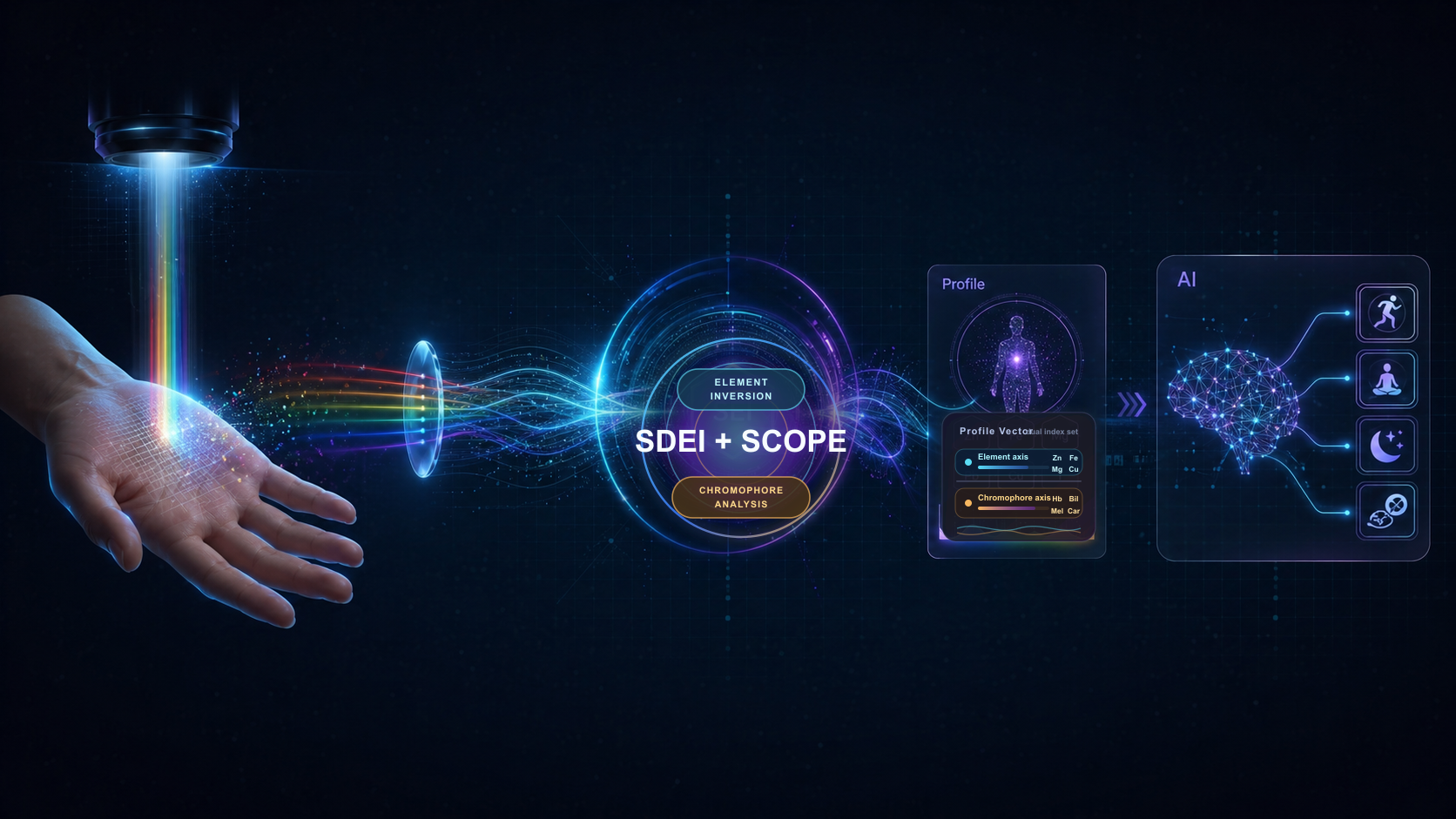
Palm-skin Diffuse Reflectance Spectra
Uses visible light to illuminate palm skin and collect diffuse reflectance spectra returned by tissue; light propagates through the epidermis, stratum corneum, shallow dermis, microcirculation, and scattering structures to form continuous skin optical fingerprints

SDEI Element-status Indices
Around 31 element-related status expressions, continuous spectra are corrected, feature-extracted, and model-transformed into comparable, trackable chronic element-status profiles

SCOPE Skin Chromophore Omics
Uses 15 physically grounded chromophore indicators to describe hemoglobin, bilirubin, melanin, carotenoids, and related microcirculation, oxidation, pigmentation, and metabolic status

Professional Models and Loops
Structures dual-pillar profiles as inputs for scenario models, supporting stratification clues, trend tracking, follow-up management, and real-world data accumulation
Palm Spectrum Acquisition
Visible light illuminates palm skin to collect continuous diffuse reflectance spectra
Spectral Quality Control
Identifies acquisition effects from posture, contact, ambient light, and abnormal waveforms
Optical Correction and Features
Performs correction, smoothing, normalization, and multi-channel feature construction
Dual-pillar Indicators
Generates SDEI element-status and SCOPE chromophore-status profiles for relative deviation, structural features, and dynamic trends
Scenario Model Analysis
Combines age, population, scenario, and professional data to provide stratification clues and trend references
Professional Loop
Supports auxiliary assessment, follow-up management, and data accumulation in clinical, research, and public-health contexts
Key Technical Capabilities
From stable acquisition to SDEI + SCOPE dual-pillar models, supporting field-ready, scalable, and closed-loop applications
Core Capabilities
From laboratory validation to real-world application
These key capabilities support the platform’s move from laboratory validation into real-world professional use, allowing one low-burden acquisition to serve SDEI element status, SCOPE chromophore status, long-term trend tracking, and professional scenario models
Skin Optical Window
Uses the palm as a stable acquisition site to record integrated optical features from shallow tissue, microcirculation, chromophore absorption, and the local microenvironment
Standardized Acquisition and QC
Controls posture, contact, ambient light, abnormal waveforms, and data integrity to improve multi-scenario usability
Multi-channel Signal Engineering
Extracts shape, ratio, slope, distribution, and channel-combination features from continuous spectra as a shared feature foundation for SDEI and SCOPE
Dual-pillar Status Profile
Builds interpretable, cross-checkable, and trackable status expression around SDEI element-related status and SCOPE chromophore-related status
Five-dimensional Evidence Matrix
Building a verifiable technology evidence chain from physical basis and method stability to real-world applications
Physical Basis
Uses visible-light diffuse reflectance, the skin optical window, and continuous spectral features to establish the physical source of skin spectromics information
Method Stability
Uses standardized acquisition, quality control, repeatability evaluation, and batch consistency validation to assess output stability across scenarios
Cross-reference Evidence
Pairs SDEI and SCOPE outputs with clinical gold standards or professional references such as blood tests, standard scales, and clinical records to evaluate directional, stratification, trend, and boundary consistency
Biological Plausibility
Examines compatibility with scientific literature and mechanism knowledge around element-related pathways, chromophore physical priors, microcirculation, oxidative stress, metabolic status, and chronic exposure
Real-world Application
Uses multi-center, multi-region, and field-application data to continuously assess usability in research, public safety, grassroots services, and professional management, while documenting where the system applies and where it does not
Lianbao uses a five-dimensional evidence matrix to support the credibility of its core technology, covering the physical basis and methodological stability of spectral measurement while using cross-reference studies, biological plausibility, real-world applications, and boundary documentation to continuously evaluate the interpretability, applicable scope, and application value of SDEI and SCOPE across populations and scenarios
Application-enabling Technical Features
Affordable, repeatable, long-term trackable data acquisition for research cohorts, high-risk identification, and professional management
Rapid On-site Assessment
Non-invasive acquisition quickly forms structured status results on site for ports, public safety, grassroots services, and other efficiency-sensitive contexts
High-throughput Cohorts
Lowers the barrier to large-sample acquisition, speeds research sample collection, and supports multi-endpoint model studies, rare-sample accumulation, and real-world data deposition
Miniaturized for Deployment
Device form factor supports mobile assessment, grassroots sites, and cross-region collaboration for scaled service coverage
Stratified Management and Referral
Extends a single assessment into trend tracking, risk stratification, and recommendations for further medical evaluation, supporting professional management and referral when needed
Data Assets
Accumulates high-quality data through standardized acquisition and scenario applications to optimize reference norms, professional models, and application strategies
Skin Spectromics Technology Ecosystem
Using medical devices as the entry point to connect SDEI + SCOPE dual pillars, professional models, real-world data, and long-term data assets

Technology Ecosystem
Skin Spectromics Platform
Standardized acquisition, SDEI element status, SCOPE chromophore status, and professional models form an iterating technology foundation
Lianbao uses registered medical-device products as the carrier to connect standardized acquisition, SDEI element status, SCOPE skin chromophores, professional models, and real-world scenarios into a continuously iterating technology ecosystem. Each standardized acquisition can become a trackable data asset, and each scenario application can feed back into reference norms, model optimization, application boundaries, and professional large-model development, allowing skin spectromics to keep evolving across research cohorts, high-risk identification, grassroots services, and professional health management